What Does a Patent Look Like? The Parts of a US Patent Explained
What a US patent looks like, page by page: the front page, the drawing sheets, the written specification and the claims, and what each part is for.
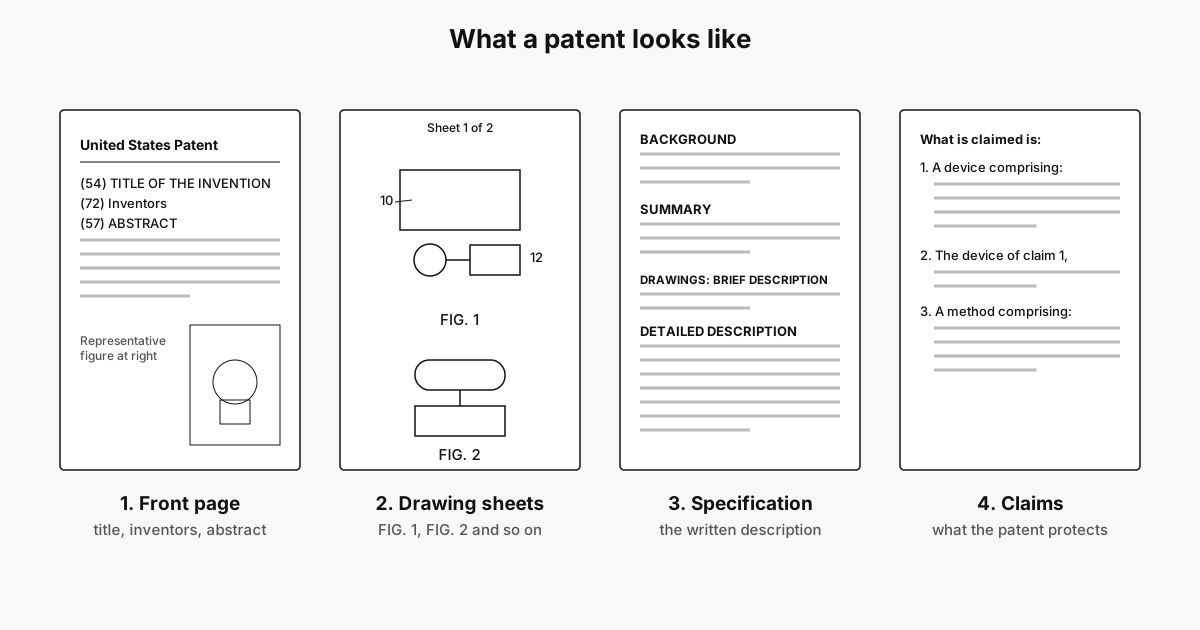
A US patent is made of four parts in a fixed order: a front page, the drawing sheets, the specification and the claims. If you have never opened one, the first thing to know is that it reads like a technical report with pictures, not like a certificate. This guide walks through each part, what it is for, and what to look at first.
1. The front page
The first page is a data sheet. It carries the patent number, title, inventors, assignee (if there is one), filing and grant dates, classification codes, and a short abstract of about 150 words. Most patents also print one representative figure from the drawings, so a reader can see the idea at a glance.
2. The drawing sheets
Next come one or more sheets of drawings. Each figure is labelled FIG. 1, FIG. 2 and so on, and each part is tagged with a reference numeral joined to the part by a short lead line. The sheets are black and white, with line weights and margins set by 37 CFR 1.84. Software patents usually show a system block diagram and a flowchart in place of a product view; our guide to sample patent drawings shows each common figure type.
The drawings are the fastest way to understand an invention. Read them before the text.
3. The specification
The specification is the written description. It usually runs in this order:
- Background: the field and the problem the invention addresses.
- Summary: a short statement of the invention.
- Brief description of the drawings: one line per figure, such as "FIG. 1 is a perspective view of the device."
- Detailed description: how the invention is built and used, walking through the figures and naming every part by its reference numeral.
The detailed description is where the drawings and the text meet. Every numeral in the text must appear in a figure and the other way round, which is why reference numerals get so much attention at filing.
4. The claims
The claims come last and are the part that matters legally. They are numbered sentences, each one defining the boundary of what the patent protects. Independent claims stand alone ("1. A device comprising: ..."), and dependent claims narrow an earlier claim ("2. The device of claim 1, wherein ..."). When people argue about whether something infringes, they argue about the claims, not the drawings.
How the parts fit together
The parts check each other. The claims name the features, the description explains them, and the drawings must show every feature that is claimed. A patent application whose claims mention a part that no figure shows will draw an objection from the examiner.
Granted patent vs. application
A patent application is filed as a specification, claims, abstract and drawings, plus forms. After it is examined and granted, the USPTO prints it in the layout above, with the front page first. A published application looks similar but carries an application publication number instead of a patent number.
If you are preparing your own drawings
Start from the claims and make sure each claimed feature appears in at least one figure, then number the parts and check the sheet against the drawing rules. PatentStroke's AI patent drawing tools make a first draft from a photo, sketch or claim and lay it out on USPTO sheets; the figure checker tests margins, line weight, text height and figure labels on drawings you already have. Review every figure before you file. More about making patent drawings from photos, sketches and text is on the home page.
Frequently asked questions
What does a patent look like?
A US patent is a document of four parts: a front page with the title, inventors and abstract; drawing sheets numbered FIG. 1, FIG. 2 and so on; a written specification that describes the invention; and numbered claims that define what the patent protects.
What does a patent application look like compared with a granted patent?
They hold the same content in a different layout. An application is filed as a specification, claims, abstract and drawings, plus forms. A granted patent is printed with a front page, then the drawings, then the specification and claims, and carries a patent number.
Do all patents have drawings?
Not all, but most do. Under 35 U.S.C. 113 a drawing is required where it is needed to understand the invention, and 37 CFR 1.81 applies that to inventions that can be shown in a drawing. Patents on a composition of matter or a process with nothing to depict may have none.
How many pages is a patent?
There is no fixed length. A simple mechanical patent might run 10 to 20 pages including drawings, while software and biotech patents are often much longer. The claims are usually one to a few pages at the end.
Where can I see real patents?
Google Patents and the USPTO Patent Public Search both show full patents. Open the Drawings tab or scroll to the drawing sheets to see how figures are laid out, and read the claims last.